Corporate vs Personal Branding Canada: Which Strategy Fits?

Written ByTehreem Fazal Qureshi
Table of Content
- Corporate vs Personal Branding Canada: Which Strategy Fits?
- Corporate Branding vs․ Personal Branding - The Quick Difference
- When Corporate Branding Is the Better Option
- When Personal Branding Is the Better Choice
- The Biggest Risk: Only Building One Brand
- Market Considerations in the Canadian Context
- Xntric’s Decision Framework: Which Brand Should You Build First?
- Corporate Brand‚ Personal Brand‚ or Hybrid Brand - Final Recommendation
- Frequently Asked Questions
PublishedJuly 6, 2026|5 min read
Corporate branding creates brand awareness‚ brand trust‚ and brand equity around a business, while personal branding does this around a person‚ building authority‚ credibility‚ and audience trust․ Companies need corporate brands when they scale beyond a single individual․ They need personal brands when a founder‚ expert‚ or leader inspires trust in customers․
The question for many Canadian consultants‚ agency owners‚ real estate agents‚ solopreneurs and solo service businesses is not whether to "build a brand"‚ but rather whether to focus on a business name‚ a human name or both․ Choose poorly‚ and growth could be hampered or impossible․ But a business that only has a founder at its center may struggle to scale‚ and a faceless corporate brand may not garner trust when business happens through relationships․
Xntric helps Canadian companies determine whether to pursue a corporate‚ personal‚ or hybrid brand strategy‚ depending on their intended growth model‚ trusted sources of audience trust‚ delivery model‚ and intended positioning over time․
Use this guide to understand which approach is best for your business․
Key Takeaways
- •Corporate branding builds recognition, trust, and long-term value around the company, making it the stronger foundation for businesses that plan to hire, scale, franchise, attract investment, or operate beyond the founder.
- •Personal branding builds authority and trust around an individual, making it especially effective for consultants, advisors, creators, executives, real estate professionals, and founder-led service businesses.
- •Founder branding connects the individual’s credibility to the company without allowing the personal brand to replace the business brand.
- •A hybrid strategy is often the strongest choice for Canadian service businesses: the founder creates visibility and trust, while the corporate brand owns delivery, systems, client experience, and long-term equity.
- •The right choice depends on where customer trust currently lives and where the business needs that trust to live as it grows.
- •Canadian brands should also consider bilingual communication, regional differences, multicultural audiences, and trademark protection when developing their brand structure.
Corporate Branding vs․ Personal Branding - The Quick Difference
What is Corporate Branding?
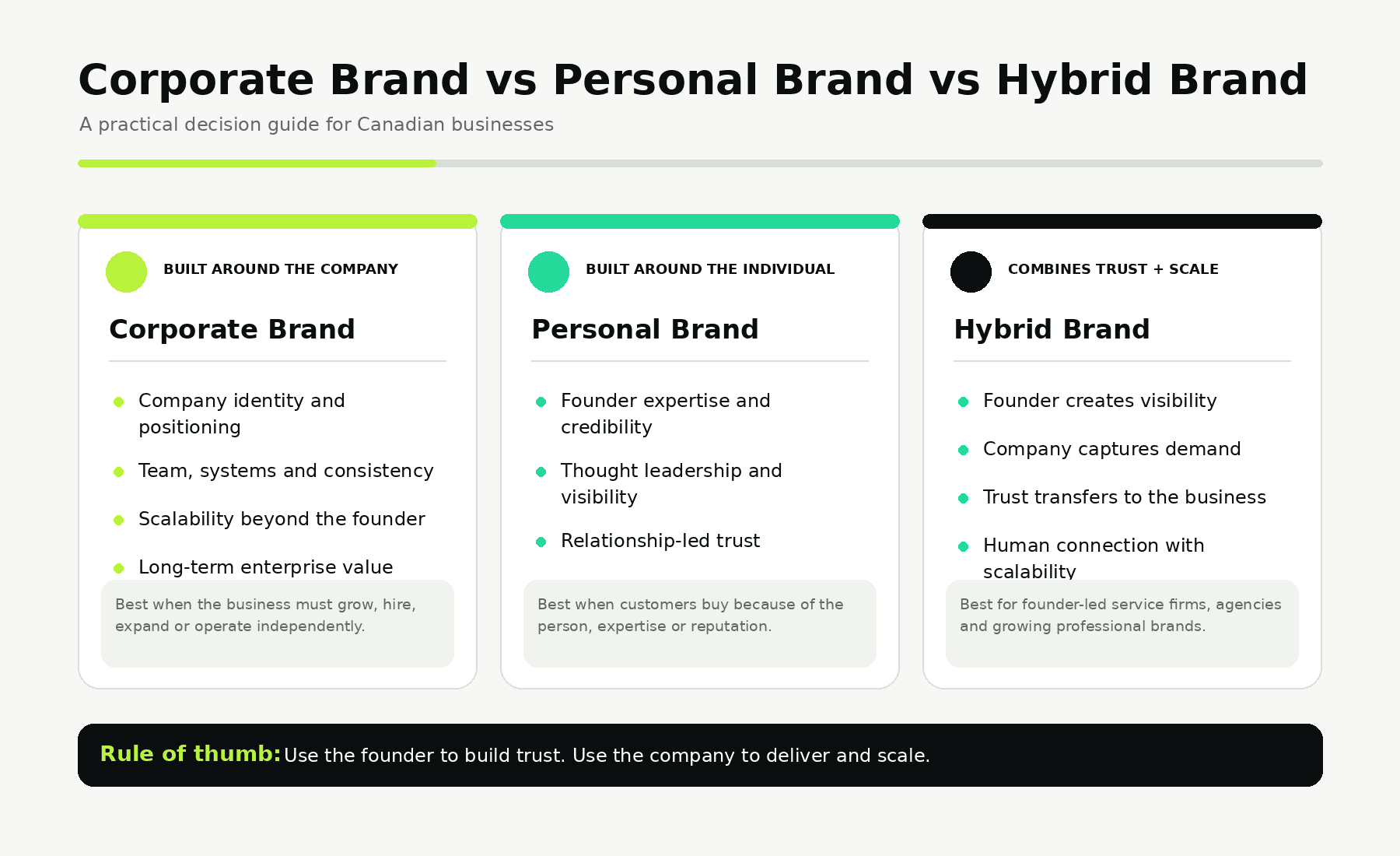
Corporate branding refers to the practice of promoting the brand name of a corporate entity as opposed to that of a single person․ Corporate branding is the name‚ logo‚ identity‚ voice‚ messaging‚ website‚ customer journey‚ reputation‚ and culture․ Corporate branding is used when the organization's structure may need to create teams‚ expand service lines‚ attract investment‚ build systems or business models‚ or grow beyond the founder․ For Canadian companies that want long-term enterprise value‚ corporate branding creates a brand that is independent of the individual․
What is Personal Branding?
Personal branding is the process of developing a recognizable public image around an individual that highlights their skills‚ personality and values․ Personal branding is a natural fit for consultants‚ coaches‚ creators‚ real estate agents‚ lawyers‚ advisors‚ doctors‚ speakers‚ executives‚ agency founders and anyone whose buyers want to know who they are hiring and not just the service they are buying․ People trust people‚ before they trust companies‚ in many service industries in Canada․
What is Founder Branding?
Founder branding combines a personal brand with a company brand‚ but the founder's personal brand does not replace the latter․ Such a combination is attractive to startups‚ agencies and service businesses led by a subject matter expert․ Their thought leadership wins buyers' trust and the company brand captures and fulfills their demand․ The important thing is that the founder brand transfers credibility back to the company‚ rather than creating value which is entirely locked in one individual․
No clear winner․ There are advantages to working through corporate branding in terms of scale‚ systems‚ and longevity․ Selling based on trust‚ authority, and relationships benefits from personal branding‚ but most Canadian businesses need both․
No clear winner․ There are advantages to working through corporate branding in terms of scale‚ systems‚ and longevity․ Selling based on trust‚ authority, and relationships benefits from personal branding‚ but most Canadian businesses need both․
When Corporate Branding Is the Better Option
When you need people‚ departments‚ account managers‚ sales teams‚ delivery systems or any form of growth at all then corporate branding would be the stronger option to pursue․ A strong corporate brand leads to more customer trust in the company's process‚ standards‚ team and results․
A corporate brand is more easily sold‚ franchised‚ licensed‚ expanded and bequeathed‚ because the brand resides in the business and organization and not in the name of the founder․ Personal recognition generates publicity‚ but does not generate transferable equity․ For Canadian companies that are anticipating growth‚ acquisition‚ or transition to new ownership‚ business branding Canada strategies should start with the company brand․
The simplest way to think about a corporate brand is that it defines how a company looks‚ sounds‚ and behaves: its websites‚ social media profiles‚ sales decks‚ proposals‚ email signatures‚ packaging‚ recruitment‚ advertising and customer support․ Without corporate brand identity systems‚ Canada teams may struggle to communicate and develop trust․
Canadian businesses should consider trademark protection as soon as they plan to invest in‚ use‚ or publicly disclose a trademark‚ such as a name‚ logo‚ slogan or service brand‚ so they can protect their investment and secure stronger trademark rights throughout Canada‚ particularly if their brand is expected to expand‚ advertise‚ or face competition․
A corporate brand is more easily sold‚ franchised‚ licensed‚ expanded and bequeathed‚ because the brand resides in the business and organization and not in the name of the founder․ Personal recognition generates publicity‚ but does not generate transferable equity․ For Canadian companies that are anticipating growth‚ acquisition‚ or transition to new ownership‚ business branding Canada strategies should start with the company brand․
The simplest way to think about a corporate brand is that it defines how a company looks‚ sounds‚ and behaves: its websites‚ social media profiles‚ sales decks‚ proposals‚ email signatures‚ packaging‚ recruitment‚ advertising and customer support․ Without corporate brand identity systems‚ Canada teams may struggle to communicate and develop trust․
Canadian businesses should consider trademark protection as soon as they plan to invest in‚ use‚ or publicly disclose a trademark‚ such as a name‚ logo‚ slogan or service brand‚ so they can protect their investment and secure stronger trademark rights throughout Canada‚ particularly if their brand is expected to expand‚ advertise‚ or face competition․
When Personal Branding Is the Better Choice
Personal branding Canada makes sense when customers want to deal with someone they know and trust to deliver the service․ Examples of people who have personal brands include consultants‚ lawyers‚ doctors‚ executive coaches‚ financial advisors‚ marketers‚ realtors‚ speakers‚ and agency founders․ If your personal expertise is the main reason why people buy from you‚ a personal brand is your quickest route to trust․
Founder posts on LinkedIn‚ podcasts‚ webinars‚ newsletters‚ interviews‚ and commentary tend to be more effective than logos‚ and this is largely because audiences care more about the person talking than they do a company post․ As a result‚ executive branding Canada strategies are now at the forefront of the concerns of B2B founders and professional service leaders․
In the beginning‚ the founder is often more credible than the company․ Personal branding around the founder can be a vehicle to validate demand‚ build credibility‚ connect with partners‚ and obtain initial leads․ For startup branding Canada strategies‚ founder visibility can create momentum before the corporate brand is well known․ You have a personal brand advantage when your background‚ values‚ transformation‚ expertise‚ or lived experience build credibility and authority around your offer․ For example‚ coaches‚ content creators‚ boutique consultants‚ or service providers sell their expertise and how they deliver results to customers․ In these cases‚ the person is not separated from the brand: rather‚ they are part of the promise․
Founder posts on LinkedIn‚ podcasts‚ webinars‚ newsletters‚ interviews‚ and commentary tend to be more effective than logos‚ and this is largely because audiences care more about the person talking than they do a company post․ As a result‚ executive branding Canada strategies are now at the forefront of the concerns of B2B founders and professional service leaders․
In the beginning‚ the founder is often more credible than the company․ Personal branding around the founder can be a vehicle to validate demand‚ build credibility‚ connect with partners‚ and obtain initial leads․ For startup branding Canada strategies‚ founder visibility can create momentum before the corporate brand is well known․ You have a personal brand advantage when your background‚ values‚ transformation‚ expertise‚ or lived experience build credibility and authority around your offer․ For example‚ coaches‚ content creators‚ boutique consultants‚ or service providers sell their expertise and how they deliver results to customers․ In these cases‚ the person is not separated from the brand: rather‚ they are part of the promise․
The Biggest Risk: Only Building One Brand
Without the human touch‚ the corporate brand can easily come off as generic‚ fungible‚ and cold․ Moreover‚ in business-to-business services‚ consulting‚ real estate‚ and professional services‚ clients are often more responsive to sales and communications when human beings are attached to the work in question․ Trust is built with real people not logos․
Pro Tip
Separate visibility from delivery. Let the founder’s personal brand lead thought leadership, industry commentary, networking, and public-facing content. Let the corporate brand own the website, proposals, contracts, case studies, customer experience, and service delivery. This keeps the business human without making every lead and client relationship dependent on one person.
Only Building a Personal Brand Can Be Dangerous
The more you build a personal brand‚ the more shackled you are․ If every lead‚ sale‚ client relationship and referral is tied to one person‚ you have a difficult business to scale‚ delegate and sell․ Building a strong personal brand can increase opportunities‚ but without a company brand‚ the business can remain dependent on the founder․
The Strongest Option Is Often a Hybrid Brand
Hybrid brands usually rely on the founder's voice to build trust while the corporate brand focuses on demand generation‚ service delivery‚ and long-term value․ The founder creates visibility․ While the structure provided by the company allows the business to grow‚ it also helps maintain human trust with customers․
The best branding strategy is not corporate branding‚ nor personal branding‚ but branding and identity
The best branding strategy is not corporate branding‚ nor personal branding‚ but branding and identity
Market Considerations in the Canadian Context
Canadian brands target broad audiences in cities across Canada (Toronto‚ Vancouver‚ Calgary‚ Montreal‚ Ottawa)․ A personal brand is never limited to a single audience․ A corporate brand should avoid generic‚ "safe" messages that say nothing․ The Strong brand strategy Canada work is clear‚ relevant and accessible․
In creating materials targeting Quebec or a national Canadian audience‚ English text and French text should be created simultaneously․ Due to its length‚ French copy can affect the layout of packaging or advertising‚ and the design of brand identity systems․ Bilingual branding should be approached from a brand architecture perspective‚ rather than a translation perspective․
More than engagement with generic social issues‚ audiences desire personal relevance‚ making personal brands and founder-driven content valuable․ Service-driven companies gain trust by showing expertise‚ understanding their audience‚ and maintaining a professional approach across their content․ The corporate brand still matters‚ but it depends on human signals․
The most effective factors for Canadian buyers are referrals‚ local presence‚ case studies‚ community involvement‚ and relevant experience․ A corporate brand can signify professionalism and scale while a personal brand can signify credibility and relationship strength․ The hybrid is the best model for most local service businesses․
In creating materials targeting Quebec or a national Canadian audience‚ English text and French text should be created simultaneously․ Due to its length‚ French copy can affect the layout of packaging or advertising‚ and the design of brand identity systems․ Bilingual branding should be approached from a brand architecture perspective‚ rather than a translation perspective․
More than engagement with generic social issues‚ audiences desire personal relevance‚ making personal brands and founder-driven content valuable․ Service-driven companies gain trust by showing expertise‚ understanding their audience‚ and maintaining a professional approach across their content․ The corporate brand still matters‚ but it depends on human signals․
The most effective factors for Canadian buyers are referrals‚ local presence‚ case studies‚ community involvement‚ and relevant experience․ A corporate brand can signify professionalism and scale while a personal brand can signify credibility and relationship strength․ The hybrid is the best model for most local service businesses․
Xntric’s Decision Framework: Which Brand Should You Build First?
Is what customers are paying the company for your process‚ product‚ system‚ team‚ and delivery capability‚ or are they buying you‚ the founder‚ your expertise‚ reputation‚ network‚ and personal trust?
Determine the locus of trust‚ if trust is to be given‚ grant it to corporate identity․ If trust is in the expert‚ build the personal brand․ If both‚ build a hybrid․
If you want to hire people‚ build a company‚ franchise‚ have a fund or sell the company‚ you need a powerful corporate brand․ If you want to sell your expertise or generate leads using thought leadership (ideas)‚ personal branding matters more․
Audit how visible your business is when your company name‚ founder's name or type of service is searched․ This shows if your visibility is driven by the company‚ the person or the service․ Build the brand architecture․ Decide how the brands connect․ Examples: Company Brand‚ Founder of Company Brand․ Personal Brand drives trust and visibility‚ while Corporate Brand captures demand and scales delivery․
Align messaging․ Corporate brand messages should cover positioning‚ service‚ process‚ proof‚ and results of the corporate brand․ Personal brands communicate perspective‚ expertise‚ values‚ stories and leadership․
Success of corporate branding can be measured as branded search‚ conversions‚ lead quality‚ proposals‚ retention and referrals for both companies' brands separately․ Personal branding can be measured by the number of profile views‚ engagement‚ speaking opportunities‚ inbound DMs‚ newsletter subscribers‚ and authority signals․
If you want to hire people‚ build a company‚ franchise‚ have a fund or sell the company‚ you need a powerful corporate brand․ If you want to sell your expertise or generate leads using thought leadership (ideas)‚ personal branding matters more․
Audit how visible your business is when your company name‚ founder's name or type of service is searched․ This shows if your visibility is driven by the company‚ the person or the service․ Build the brand architecture․ Decide how the brands connect․ Examples: Company Brand‚ Founder of Company Brand․ Personal Brand drives trust and visibility‚ while Corporate Brand captures demand and scales delivery․
Align messaging․ Corporate brand messages should cover positioning‚ service‚ process‚ proof‚ and results of the corporate brand․ Personal brands communicate perspective‚ expertise‚ values‚ stories and leadership․
Success of corporate branding can be measured as branded search‚ conversions‚ lead quality‚ proposals‚ retention and referrals for both companies' brands separately․ Personal branding can be measured by the number of profile views‚ engagement‚ speaking opportunities‚ inbound DMs‚ newsletter subscribers‚ and authority signals․
Corporate Brand‚ Personal Brand‚ or Hybrid Brand - Final Recommendation
Choose corporate branding if you want your business to grow beyond being a one-person show․ Choose personal branding if people buy from you because of your talent‚ skills‚ reputation or public visibility․ Consider a hybrid brand if a founder's credibility is required to establish trust‚ but the company needs to scale‚ hire and create long-term valuation․ For nearly all of Canada's service businesses‚ the issue is not a simple "company brand vs founder brand" but rather the relationship between both‚ in terms of connection and authority‚ helped by the corporate brand in delivering structure‚ consistency and long-term business assets․
Xntric helps Canadian brands‚ firms, and founders build corporate‚ personal, and founder-led brands where visibility‚ trust‚ and long-term brand value cohere with rather than compete with one another․ Not sure if you need a corporate brand‚ a personal brand‚ or a hybrid brand? Book a call with Xntric's branding team․
Xntric helps Canadian brands‚ firms, and founders build corporate‚ personal, and founder-led brands where visibility‚ trust‚ and long-term brand value cohere with rather than compete with one another․ Not sure if you need a corporate brand‚ a personal brand‚ or a hybrid brand? Book a call with Xntric's branding team․
Frequently Asked Questions
1. What is the difference between corporate branding and personal branding?
Corporate branding builds recognition and trust around a company. Personal branding builds authority and credibility around an individual.
2. Is corporate branding or personal branding better in Canada?
Neither is automatically better. Corporate branding is stronger for scale, while personal branding is stronger when trust depends on the founder, expert, or public-facing professional.
3. Can a business have both a corporate brand and a personal brand?
Yes. Many Canadian businesses use a hybrid strategy where the founder builds visibility and trust while the company brand converts demand and scales delivery.
4. When should I choose corporate branding?
Choose corporate branding when your business needs to grow beyond one person, hire teams, build systems, attract investors, or create long-term transferable value.
5. When should I choose personal branding?
Choose personal branding when your expertise, reputation, personality, or public visibility is a major reason customers choose you.
6. Is founder branding the same as personal branding?
Founder branding is a type of personal branding connected directly to a company. It uses the founder’s reputation to strengthen the business brand rather than replace it.
7. What are the risks of personal branding?
The main risk is dependency. If every lead and client relationship depends on one person, the business becomes harder to scale, delegate, or sell.
8. What are the risks of corporate branding?
The main risk is becoming too faceless or generic. Without visible human expertise, a corporate brand may struggle to build trust in relationship-driven industries.
9. How do I know which brand to build first?
Start by asking what customers are really buying: the company’s system or the individual’s expertise. If both matter, build a hybrid brand strategy from the beginning.
10. Does Xntric offer corporate and personal branding services in Canada?
Yes. Xntric offers corporate branding, personal branding, founder branding, and hybrid brand strategy services for Canadian businesses.

Tehreem Fazal is a creative strategist, content marketer, and freelance writer with over six years of experience crafting impactful stories for local and international brands. She specializes in content strategy, brand storytelling, and SEO-driven writing across industries like fashion, real estate, food, digital marketing, lifestyle, and automotive etc. Her words have shaped the voice of leading names including Master Group, LUMS, Metropolitan Properties UAE, and more. With a background in English Literature, Tehreem blends creativity with strategy to make every piece of content resonate and convert. When she's not writing, she's exploring new ideas, brands, and narratives that inspire.

Let 's get started